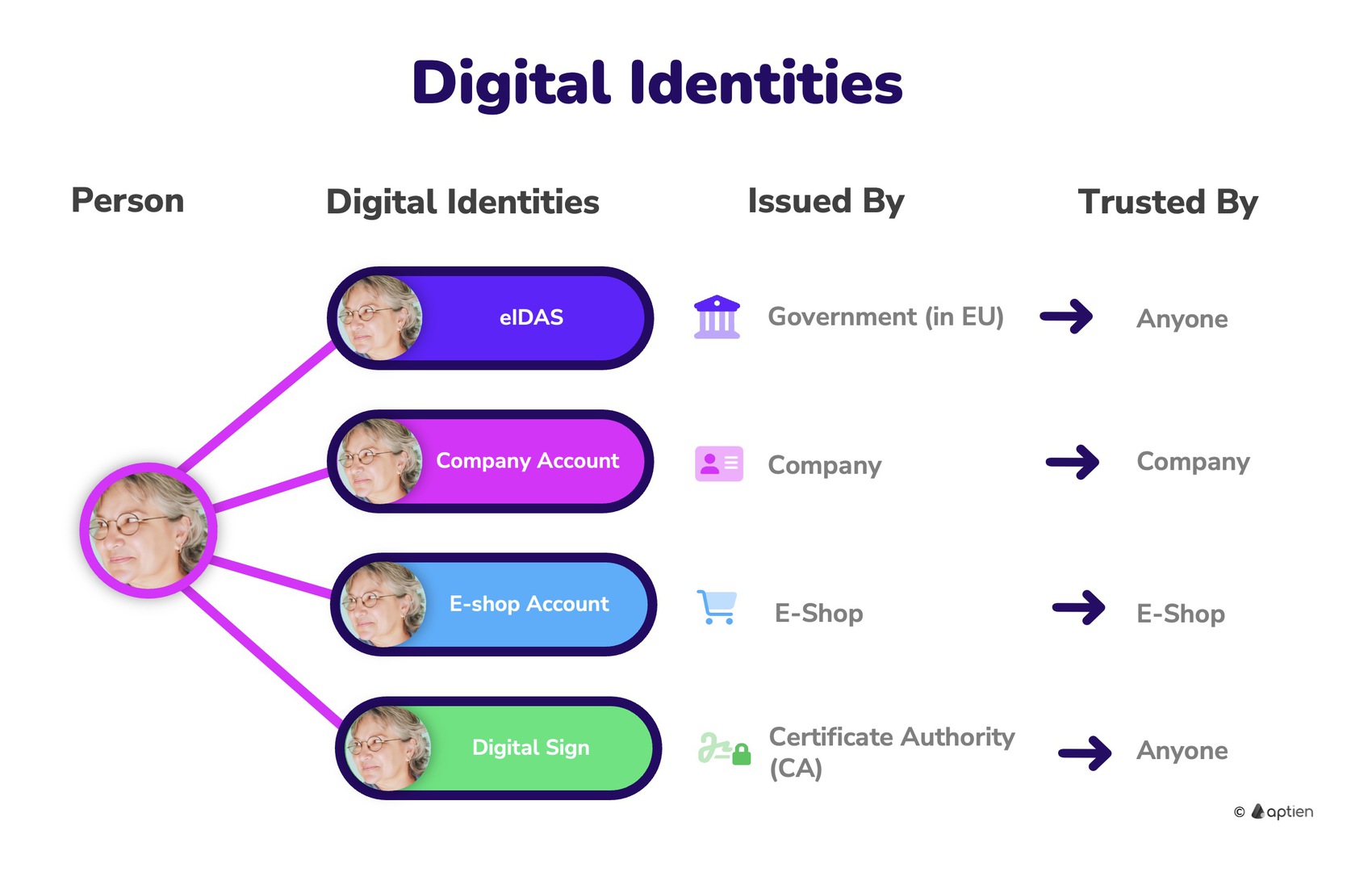
Digital identity is an equivalent of a person in the digital world—basically your “ID card on the internet.” Just like a driver’s license, passport, or employee badge in the physical world, you have a digital identity online. It’s the set of information and data that identifies you as an individual in the digital environment. As in the physical world, you can have multiple digital identities (for example, personal, work, or for specific apps and services). It depends on who verifies it, who issues it, who accepts it, and who trusts the verification (proving you are who you say you are).
What Does a Digital Identity Look Like? Examples of digital identities
A digital identity can take many forms with different levels of assurance and trust. Here are common types you’ll encounter:
- Google account
- Apple ID
- Email account (the most common digital identity)
- Bank-verified identity (high assurance; e.g., BankID in the EU)
- Qualified digital signature (highest legal assurance in the EU/eIDAS)
- Electronic signature
- Employee/User account in a business application (verified by the employer; strong assurance inside the company)
- User account in Aptien
Who issues, guarantees, and recognizes a digital identity?
For any digital identity, what matters is who issues it, how it’s verified, and who accepts it. Your use case also matters—signing in to an online store is different from signing a loan or contract.
- In Europe (eIDAS), the government or accredited providers can verify that a digital identity maps to a specific person (e.g., BankID) using official ID checks.
- In the U.S., digital identity is typically private-market and not legally assured. Google/Apple/Microsoft accounts are login credentials, but they don’t prove that “John Smith” is that exact person.
- Some services add ID verification (e.g., LinkedIn, Airbnb, Revolut). This boosts trust but is not the same as a government- or regulator-assured identity.
- Companies issue and verify identities for employees (e.g., corporate email, SSO, Microsoft Entra ID/Azure AD, Okta, Google Workspace).
- Ecommerce sites manage customer accounts, usually without verifying real-world identity beyond confirming an email or phone.
What makes up a digital identity?
- Information that uniquely identifies a person online—an identifier plus a way to verify it.
- Identifiers: username, email address, phone number, or another unique ID.
- Verification (authentication): something only you know or have—password, SMS code, PIN, authenticator app, security key, or other MFA factors.
What is the difference between the US and Europe?
There are big differences in how digital identity works in Europe versus the United States. In Europe, the eIDAS framework (a government-backed, verified digital identity system) is in place. In the US, there is no nationwide, government-verified digital identity equivalent to eIDAS.
- A Google or Apple account can be created by anyone, from anywhere.
- An email and password are enough; no ID or passport is verified.
- You can use any display name you want (“Elvis Presley,” “Mickey Mouse”).
- The identity is technical (a login), not a legally verified identity.
- Some services offer ID checks (KYC – Know Your Customer) — for example, LinkedIn, Airbnb, Revolut.
- That increases confidence a real person is behind the account, but verification is limited to that service and is not recognized by the government as an official digital identity.
Summary of digital identity differences: Europe vs. US
- Europe (eIDAS) → the government or an accredited provider guarantees that a digital identity belongs to a specific person (e.g., BankID in the Czech Republic).
- In Europe, digital identity works like an online ID card — the government issues it and guarantees it’s really you.
- US → digital identity is led by the private sector and not guaranteed by the government. Google/Apple/Microsoft accounts are essentially sign-in methods, but no one guarantees that “John Smith” is truly John Smith.
- In the US, you can create a Google or Apple account, but no one verifies that the name is real. So an account is not the same as a verified, government-recognized identity.
What Does Digital Identity Mean for Companies and Employees?
For companies, a digital identity is the foundation for using business software, managing security, and controlling access to physical locations. Companies use employees’ digital identities in many processes: to sign documents, approve requests, assign or return equipment, and manage access and permissions. Companies either rely on an identity verified by a trusted authority or verify it internally—for example, by issuing and setting up a company email account.
- Company-issued email account
- User account in a business application
- Employee ID badge or access card
Enables work in business applications and process digitization
- Sign in to business apps and software
- Sign in to various online services (ecommerce, banking, government)
- Electronically sign contracts
- Electronically approve requests or handoff records
- Allows an employee to securely view their HR information
- Allows them to confirm receipt of work equipment (instead of a wet signature)
Companies usually verify employee identities internally
- Employees also have their digital identity within the company
- The company issues it as part of internal processes and trusts it for business use
- An employee, as a signed-in and verified user of your app, is trustworthy for your company
- Enables single sign-on (SSO) to different business applications
- The identity must be protected to prevent theft, misuse, or impersonation
What you can do with Aptien Digital Identity
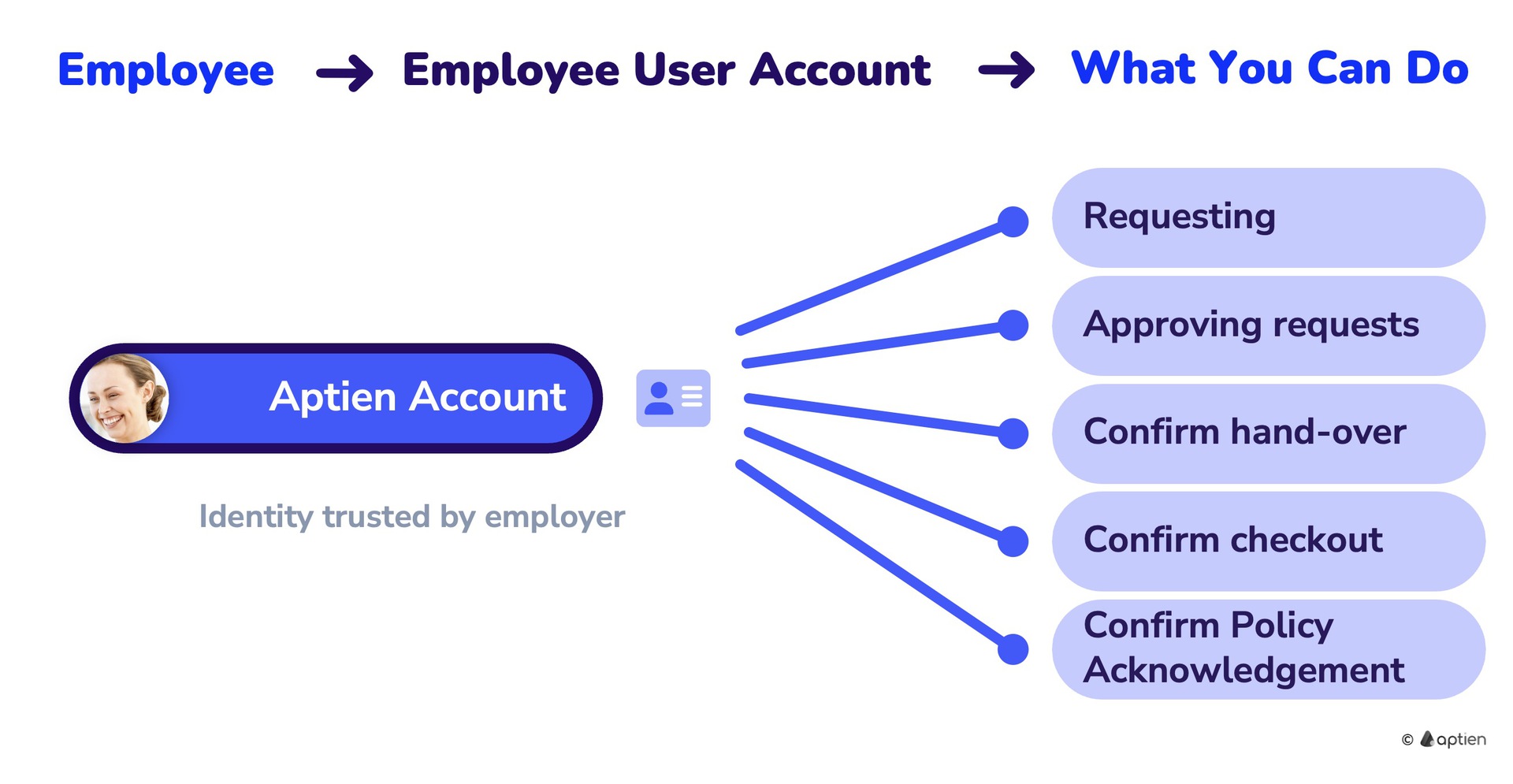
A user account in Aptien is trusted for your business because you are a verified user. Thanks to this, you can perform digital confirmation in a wide range of processes
- Submitting applications on the portal
- Approving of Employee Requests
- Confirmation of handover (property and other things)
- Acknowledgment of receipt
- Confirmation of completed training
- Confirmation of familiarization with the policy or manual