 CRM for Solar Installers
Complete Management of Solar Projects: From Sales to Service
As a company that supplies photovoltaic power plants (PV), you deal with a whole series of consecutive tasks, information, and documents for each of your projects. From the first contact with the customer to the long-term care of the installation. If these processes don't run smoothly, you only have worries, lots of extra work, and losses not only financial but also reputational. Delayed orders, overlooked permits, poor equipment records, or unfulfilled service commitments. This costs you time and money. If you supply turnkey PV systems, you need to have everything under control from sales to service.
- See how you can manage all the information about your projects, keep track of deadlines, or manage and coordinate all the work on PV projects
- You will solve the tracking of important deadlines, management and coordination of people's work, and all the documentation around PV projects
- You will have all the information in one environment, from the first negotiations with the customer to monitoring the maintenance of your installations
- You will gain control over the status of the project and automatic scheduling of deadlines
- You can easily get an overview of all orders.
- You can keep track of key deadlines on the project using trackers.
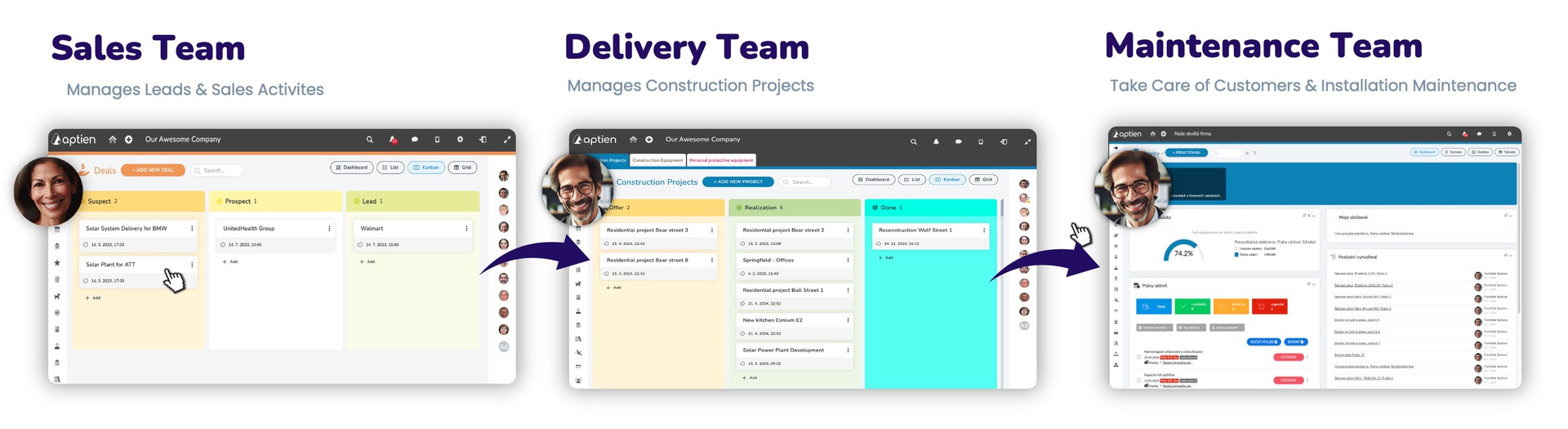
1. Sales Phase – Acquiring and Processing Inquiries
Your first contact with a customer comes from various channels – a form on your website, a phone call, a personal referral, or a meeting. The key goal of the sales phase is not only to engage the customer but, above all, to effectively guide them through the entire decision-making process: from the initial consultation to the offer and the signing of the contract.
What you must and need to address in this phase:
- Record all inquiries and sales opportunities in one system, including contact details and communication history.
- Plan and conduct technical site surveys, recording specifics of the roof, orientation, and technical limitations.
- Prepare an offer – with an overview of possible options, a preliminary calculation of production, payback period, and budget.
- Have an overview of the status of each order – who is handling it, what stage it is in, and what is missing to move forward.
The Head, Hand, Pencil, Paper, Excel System is Challenging
- Without a CRM or other system, your offers get lost in emails, notes, or spreadsheets.
- Salespeople share information informally, and as more of them join the team, chaos begins.
- You save information or photos from the site survey somewhere on the network and have difficulty finding them.
- You repeatedly have to find out the same information, which slows down responses and creates more work for you.
2. Project Execution: Managing Your Solar Installation Project
Once the contract is signed, the project begins – the sales opportunity becomes a concrete project, a solar installation job. In this phase, you need to manage the entire installation project: planning, team coordination, tracking deadlines, securing materials, and, most importantly, handling all necessary paperwork with authorities and distributors.
What you need to do in this phase:
- Track deadlines: permit approvals, notification to the distributor, grid connection.
- Have an overview of materials: which panels, batteries, and inverters are assigned to this project, when they will arrive, where they are stored.
- Coordinate installation teams – work schedule, task assignments, timetable.
- Document everything: photos, inspection reports, wiring diagrams, handover protocol, battery documentation, solar panel documentation.
- Communicate with the customer – schedule installation dates, confirmations, service instructions.
Why this is a problem without a proper tool:
- Without a project management system, it's easy to lose track of the project's status – some tasks remain unfinished, materials don't arrive on time, permits aren't processed.
- Coordination between the warehouse, electricians, and the customer happens via phone or email, leading to errors.
- You have no central place to store installation, battery, or panel documentation.
Managing Work and Tasks on a Project
Communication between the people involved in a project is key and can prevent communication or email overload. Misunderstandings or other information noise can lead to unnecessary costs or client dissatisfaction. Aptien allows you to manage work using tasks or, for example, keep records of meetings. You'll appreciate all of this as the number of people involved in the project grows or with the passage of time, when you need to remember what was done on the project.
- Tasks and work management on a project
- Keeping records and all activities related to the project
- Tracking project deadlines
- Managing project suppliers and sharing documents with them
- Managing tasks related to PV (Solar) Construction
- Manage all work around the construction using tasks
Overview of Installed Batteries, Solar Panels
- You have an overview of all components - batteries, panels, inverters - that you supplied
Handover of Solar System to Client
Aptien allows you to automatically pre-fill the handover protocol from saved data. This saves you a lot of work, as you won't have to create it manually in "Word".
- Print out protocols or work orders using printable forms
- Handover or Acceptance Protocol for Solar System Completion
3. Service and Maintenance of Your Solar PV Installations
Installation isn't the end of the job. Solar PV systems operate for 20+ years and require regular care – performance checks, panel cleaning, component replacement, and quick response to malfunctions. Companies often transition from being a supplier to a long-term manager and service partner. The operation and maintenance of these solar PV systems are just as crucial for you as the initial installation.
What You Must Manage After Project Handover:
- Maintain an overview of installed components – types of panels, batteries, inverters, their location, and serial numbers.
- Track service history – when the last inspection was performed, what was replaced.
- Respond to malfunctions – especially if it's a production outage or a safety risk.
- Plan preventive maintenance – panel cleaning, performance checks, monitoring surrounding vegetation, firmware updates for inverters.
- Maintain customer contact – reminders for inspections, performance reporting, offers for expansion.
Why This Is a Problem Without a Tool:
Without configuration records, it's almost impossible to quickly find what was installed. If a customer calls for a repair after 3 years, the team often doesn't know what's wrong – they lack service history, photo documentation, or information about the installed components.
Specialized Training for Installation Technicians
- Work Safety (working at heights, electrical equipment over 1000V)
- Training on specific types of inverters
- Training on using diagnostic equipment (thermal camera, IV tester)
- Fire safety training specific to Solar PV systems
- Training on legal requirements (inspections, Decree 50 - now NV 194/2022 Coll.)
How an Integrated System like Aptien Can Help Your Solar Business
Every phase of a solar energy project generates a large amount of data, especially when delivering complete, ready-to-use installations: business records, technical information, documents, deadlines, equipment configurations, photos, and service reports. When this information is scattered across various spreadsheets, emails, or separate software tools, it leads to disorganization and inefficiency. Here's what businesses need to manage – and why a unified system is essential:
- Centralized project management: From initial customer contact to ongoing service and maintenance.
- Comprehensive historical tracking: Keep tabs on every project, customer interaction, and equipment detail.
- Automated deadline management for all projects.
- Easy sharing of all installation-related documents.
- Mobile access: Empower your installers and service technicians with real-time access to all necessary information, even on-site.
- Automated generation of key documents like handover protocols or other reports in PDF format.
- Seamless integration of CRM (Customer Relationship Management), project management, and asset/service tracking.
- Tools for planning tasks, creating checklists, monitoring deadlines, and managing equipment configurations.
This approach significantly reduces the time you spend searching for and sharing information. Ultimately, this ensures higher service quality, a better customer experience, faster response to outages, and more efficient team management.
A system like Aptien PV is ideal for
- Solar energy system suppliers or solar power plant providers.
- Solar system designers and engineering firms (especially if they manage design and permitting).
- Solar panel installation companies or businesses offering complete solar system installations.